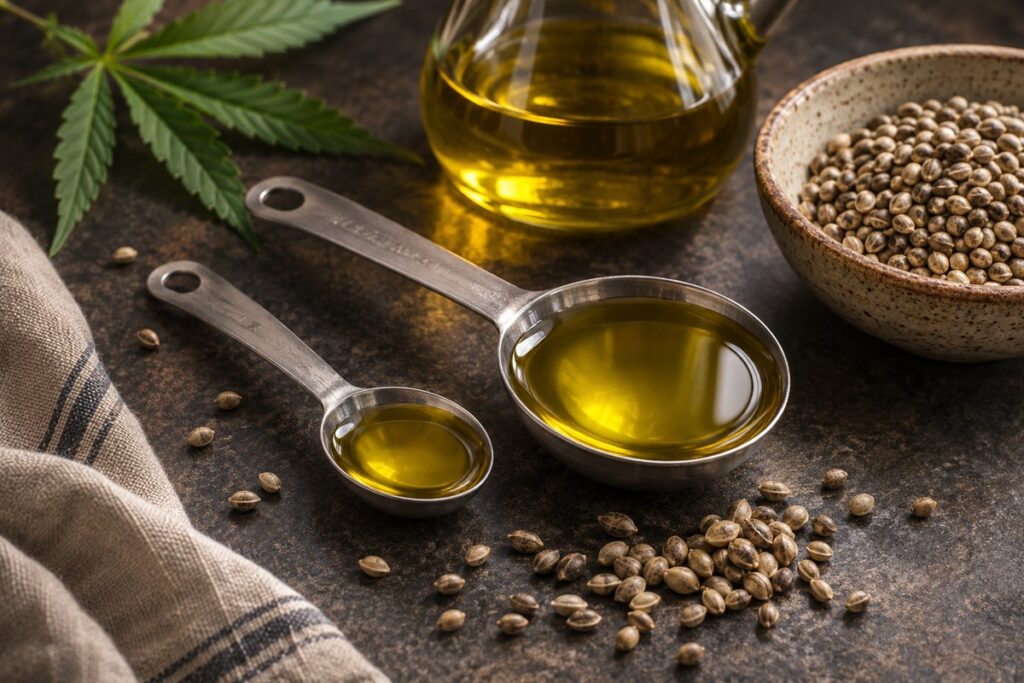
An American recipe calls for a tablespoon of hempseed oil. You misread it and add a teaspoon. With that slip, two thirds of the intended omega-3 has gone missing. Two thirds of the omega-6 has gone with it. Yet the ratio of those fatty acids is exactly what the recipe writer had in mind. For a reader trying to work out how much of either fat they will actually eat, a ratio alone leaves a surprising amount unsaid.
A frequently reported figure for hempseed oil is around three parts omega-6 to one part omega-3. That shorthand describes a chemical characteristic of the oil. To understand what went into the calculation, it helps to put the names of the fatty acids back in. The two largest contributors are generally linoleic acid, from the omega-6 family, and alpha-linolenic acid, or ALA, from the omega-3 family. Both are essential fatty acids that people obtain through their diet.
Reading past the ratio
One published analysis of oil used in a feeding study lets us look at the arithmetic. The researchers reported about 56 percent linoleic acid and 18 percent ALA among the fatty acids in their hempseed oil. Smaller contributions from other members of both families brought the overall omega-6 to omega-3 ratio to about 3.1. The paper identifies these as averages for two oil samples. That small detail is useful when another bottle or another scientific paper gives a slightly different figure.
Now imagine two servings supplying, respectively, six grams and two grams of the two families, or three grams and one gram. Both have a ratio of three to one. The first serving supplies eight grams of these fats altogether, while the second supplies four. Someone who saw only the ratio would have no way of recovering either total. Working in grams makes the size of the serving visible in a way the ratio cannot.
A seed, a spoonful and a day’s meals
The word “hemp” can also obscure what went into the spoon. A review of hempseed composition describes the oil alongside the seed’s proteins, minerals and other constituents. Pressing oil separates much of the fat from the rest of the seed. A tablespoon of oil and a tablespoon of hulled seed therefore supply different quantities of fat and different quantities of protein. A comparison of whole, hulled and germinated seeds illustrates how changing the portion of a plant that ends up on the plate changes the composition reported per gram of food.
The same logic applies to an entire day. If a dressing made with hempseed oil replaces one made with another fat, the change depends on what the original dressing contained. Adding it alongside an unchanged meal asks a different question. Averaging the ratios printed on two food labels will usually give the wrong dietary ratio. The proper arithmetic is to add the grams of each family across the foods first and then divide one total by the other.
Which omega-3 is in the bottle?
An omega-3 total also leaves out molecular identity. The main omega-3 in hempseed oil is ALA. Fish and other seafood can supply substantial amounts of longer-chain omega-3s such as EPA and DHA. The NIH Office of Dietary Supplements explains that people convert some ALA into the longer-chain forms, but the conversion is limited. Matching two foods on grams of total omega-3 would not necessarily match them on EPA or DHA.
The chemical analysis can support a straightforward claim about what a particular oil contains. Claims about what happens to people’s health require evidence in people, with a specified amount, a defined comparison and a measured outcome. Back at the table, there is a simple starting point that works for both kinds of question. The person making lunch can preserve the oil’s fatty acid ratio with either measuring spoon. To get the intended amount of each fat, they still have to read the recipe.