There are horses and little human figures on the woven hangings from Överhogdal in Sweden. Plenty of visitors could pick them out. What almost no visitor could do by looking is name the plant that supplied a pale background thread. For years the textiles appeared in the literature as flax. The trouble was that references to the cloth rarely said just how anyone had identified the fiber in the first place.
G. Skoglund, M. Nockert and B. Holst returned to this elementary question in a study of ten Scandinavian textiles from the Viking and early medieval periods. Among their samples were threads from all five pieces of the Överhogdal hangings. At issue was a familiar division of labor in the historical imagination: flax supplied fine textiles, while hemp was suited to coarse work such as rope. If that division had guided identification, using the identifications to confirm it would take the argument in a circle.
A feature the spinner did not put there
Hemp, flax and nettle can all furnish long fibers from tissue near the outside of the stem. Processing separates and cleans the material. Spinning combines fibers into a continuous thread. A weaver can take any such thread and turn it into something fine or coarse, depending on the raw material and the work put into it. A smooth thread in a decorative hanging is a clue to craftsmanship. Its elegance alone has little to say about the plant.
The researchers needed a feature of the individual fiber that survived the making of the textile. One candidate was the direction in which tiny cellulose structures wind within the fiber wall. This direction has a handedness, often described with the letters S and Z. It is quite distinct from the twist visible in a piece of yarn. A spinner can choose which way to turn the spindle. The orientation inside the plant’s fiber wall was established while the stem was growing.
How the microscope picks up a direction
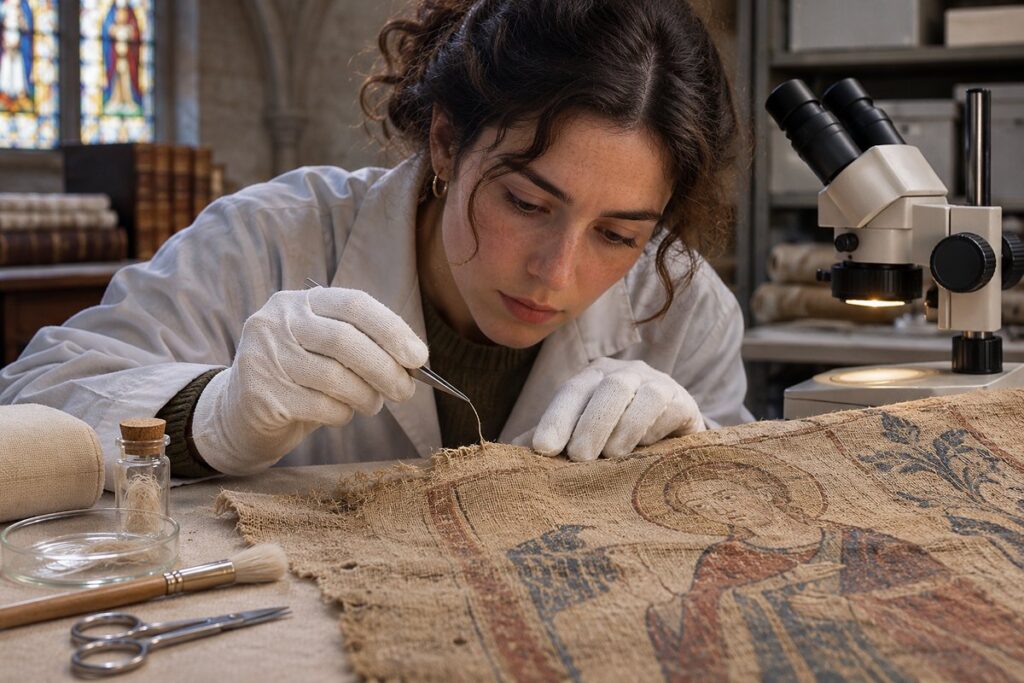
Cellulose affects polarized light differently depending on its orientation. In a microscopy procedure for identifying plant fibers, observers can examine an isolated fiber as it rotates between polarizing filters. An additional optical plate creates a color change that helps reveal its internal orientation. The colors depend on the arrangement of the instrument and the fiber. The important feature is a reproducible change with orientation, rather than a rule that every blue fiber belongs to a particular species. A separate optical analysis explains why some fibers yield a clear reading while others remain inconclusive.
For the Scandinavian study, conservators provided short samples of thread, from which single fibers were teased apart for examination. In material from two Överhogdal pieces, the team found fibers with different internal orientations. In the regional group of plants under consideration, one orientation identified hemp. The other was consistent with flax, though the researchers pointed out that nettle could also yield that reading. The evidence for the presence of hemp was firmer than a positive identification of every other fiber alongside it.
What can go back on the label?
A narrow sample can justify a surprisingly strong correction. One securely identified hemp fiber is enough to overturn the assumption that the sampled yarn consists entirely of flax. It cannot establish the proportions of the two plants throughout a hanging several feet long. Nor can it tell us whether the person who prepared the fiber deliberately blended materials, or whether they arrived together earlier in the supply chain.
That modest difference in wording matters. A museum can acknowledge hemp in an accomplished piece of decorative weaving while leaving open how widely the practice occurred. The change also gives conservators a reason to look afresh at textiles cataloged by appearance alone. For the Överhogdal hangings, the decisive evidence was tucked inside a thread that generations of viewers had looked straight past on their way to the horses.