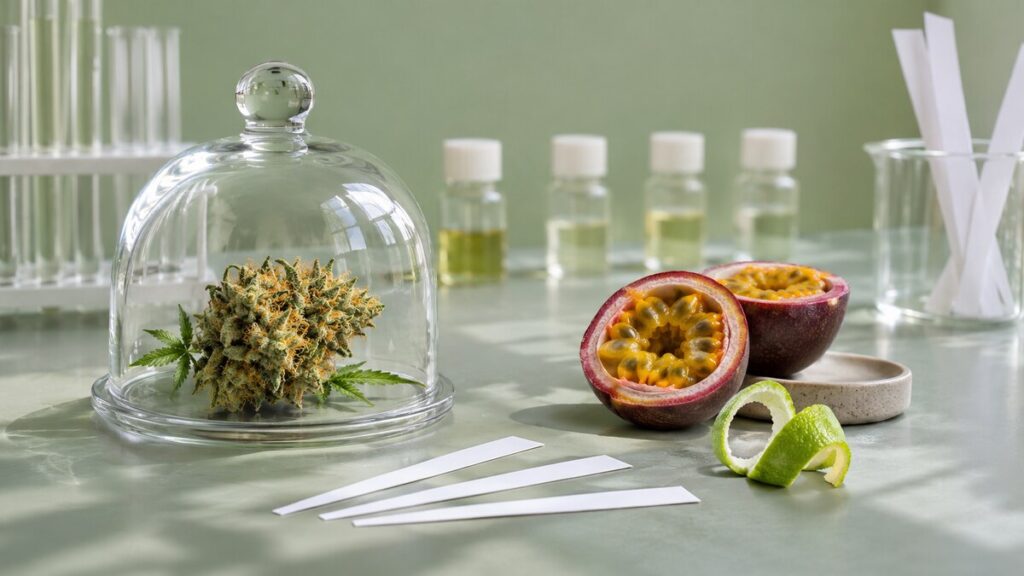
Two sample jars can carry remarkably similar lists of prominent terpenes and still smell as different as fruit and something savory. It is an awkward result for anyone hoping to predict the smell of a cannabis flower from the first three names on a chemical report. It is also a promising place to look for molecules that have been hiding in plain sight.
Starting with a nose instead of a label
“Tropical” is a word people use for a resemblance. It might call to mind passion fruit, ripe guava or the smell of juice after someone has cut a lime. The comparison does not imply that the plant contains fruit, or even that different people are responding to exactly the same sensation. If a researcher wants to explain that description, the first job is to find samples that people can reliably tell apart.
A sensory study of cannabis aromas approached the problem through human judgments of samples. Descriptive work matters because a name supplied in advance can suggest an answer. Ask whether something smells like citrus and a participant may start searching for citrus. Let several people describe coded samples and the recurring terms carry more information. Agreement still leaves open the identity of whatever prompted it. In work pairing chemical and sensory measurements, investigators compared what a detector registered with what people could smell as constituents emerged from the instrument.
Similar terpenes, different impressions
Researchers examining minor volatile compounds in cannabis compared material with markedly different aromas. They found that some familiar, relatively abundant terpenes were surprisingly similar across samples with quite different sensory profiles. Less abundant compounds, including some outside the terpene family, tracked particular sweet or savory impressions more closely. Among the candidates for citrus-like tropical notes were sulfur-containing compounds.
That sounds counterintuitive if “sulfur” brings to mind eggs, drains or matches. But the name identifies an element in a molecule, not an odor assigned to everything that contains it. The rest of the molecular structure matters, as does concentration. Earlier work on the skunky odor of cannabis identified another group of sulfur-containing volatiles. A list that reports only “sulfur present” would collapse some quite different experiences into one unhelpful category.
Why a small peak can be a good clue
Imagine tasting two soups made with the same stock. Measuring salt would tell you something important about each. If both contain almost exactly the same amount, salt becomes a weak explanation for why one smells distinctly different. It can still be essential to their shared character. The same reasoning applies to terpenes in a set of aromatic samples. Similar levels make them less informative about a difference between those samples without making them irrelevant to the overall smell.
A strong correlation also leaves a question behind. Two minor compounds may occur together so consistently that either would predict the panel’s rating. The more informative experiment would separate them, hold the rest of the mixture steady and examine what happens to the sensory judgment. That takes reference materials, controls and people willing to smell many very similar preparations. Naming the candidate is often the beginning of that work.
A more informative label would still have limits
A grower, chemist and sensory assessor can describe the same sample accurately and give three different answers. One might record the variety name, another a set of concentrations and the third an unmistakable impression of fruit. A review of scientific work on cannabis aroma surveys some of the difficulty in moving between these ways of describing a plant.
For a reader comparing two apparently similar terpene reports, the useful question is what the report actually included. A substance missing from a short list may have fallen outside the test altogether. A substance present in a tiny amount may be easy for a person to notice. Somewhere between the instrument’s reporting threshold and a person’s sensory threshold lies room for a flower to smell unexpectedly like fruit.