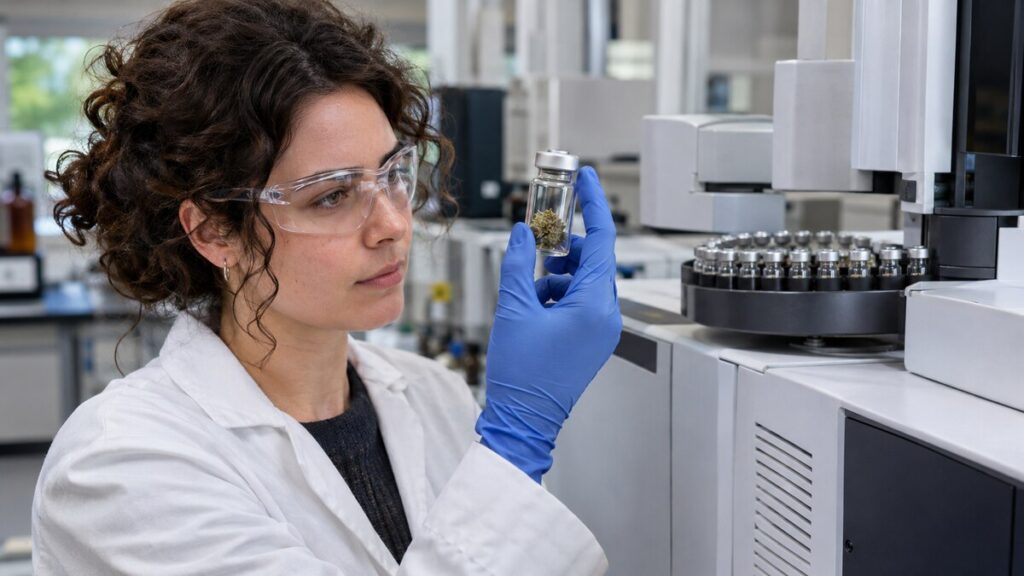
A chemist looking for the source of a smell has a peculiar disadvantage. The detector on the bench ranks molecules according to a physical signal. The person standing beside it ranks them according to what reaches the nose. The compound responsible for the most conspicuous smell in the room might barely register among the largest peaks on the instrument. Cannabis, with its unmistakable skunky note, is a case in point.
The obvious suspects were easy to measure
Cannabis flowers give off a mixture of airborne molecules. Among the best known are terpenes, a family that also contributes to the smells of many other plants. A chemical inventory may show substantial quantities of compounds such as myrcene or limonene. Yet being plentiful is a poor qualification for the job of producing a particularly recognizable odor. A mixture can be dominated by one ingredient by weight and by quite another at the nose.
Think about adding a trace of a strongly smelling ingredient to a bowl of plain rice. The rice will still account for nearly all of the mass. A person walking into the kitchen may guess the added ingredient before they guess the main one. The comparison is about detection thresholds. The quantity needed for a human to notice one chemical can be very different from the quantity needed for another, and the rest of the mixture can alter the impression.
Separating the sulfur signal
In a study of the skunky character of cannabis, researchers separated airborne constituents using two-dimensional gas chromatography. An ordinary chromatographic separation can leave two substances emerging at almost the same time. A second separation, using a different basis for distinguishing molecules, gives the chemist another chance to see what was hiding in the first signal.
The team also used a detector especially sensitive to sulfur. That choice narrowed the search without requiring that a suspect be abundant. Several related sulfur-containing compounds emerged. One in particular, 3-methyl-2-butene-1-thiol, stood out as a contributor to the characteristic odor. The tail end of the chemical name, “thiol,” identifies a group containing sulfur and hydrogen. Knowing the family gives a chemist something more useful to search for than the word “skunk.”
The difference between a match and a smell
Identifying a compound in a fragrant sample and showing that it helps produce the fragrance are separate jobs. A useful test is to compare samples that people rate differently, then ask whether the candidate tracks that difference. Another is to reconstruct a mixture and see how the impression changes when the candidate is included. Sensory evidence matters because a chromatography instrument has no experience of smelling a flower.
An earlier chemical and sensory analysis of cannabis odor paired analytical separation with people actually smelling the compounds as they emerged. The descriptors themselves come from people. In research on consumer perceptions of cannabis aromas, investigators asked assessors to describe differences among samples. Two assessors can agree that a pair smells different while reaching for different words. One person’s strongest association might be a roadside encounter with a skunk, another’s a pungent food. An experiment needs a reasonably consistent sensory distinction before a chemical difference can explain it.
One note in a larger mixture
Subsequent research on unusually sweet and savory cannabis aromas widened the search beyond the usual terpene list. It also illustrates a limit of the skunk finding. Identifying an influential sulfur compound answers a question about one recognizable feature. It does not explain every difference between two jars, much less what somebody will think of either smell.
A chemical profile and an odor description are therefore complementary records. One can report a sulfur compound where a conventional list of abundant molecules barely registers it. The other can establish that people notice a skunky note without being able to name a single constituent. The explanatory work happens where the two records meet, down among peaks a chemist looking only for the largest signals might have passed over.